Start with Wheelie, then build a small connected lot: owned land → clear ground → asphalt → directed entrance and exit → correctly facing bays. Watch a car complete the whole visit before expanding.
1. Learn the tools in Wheelie
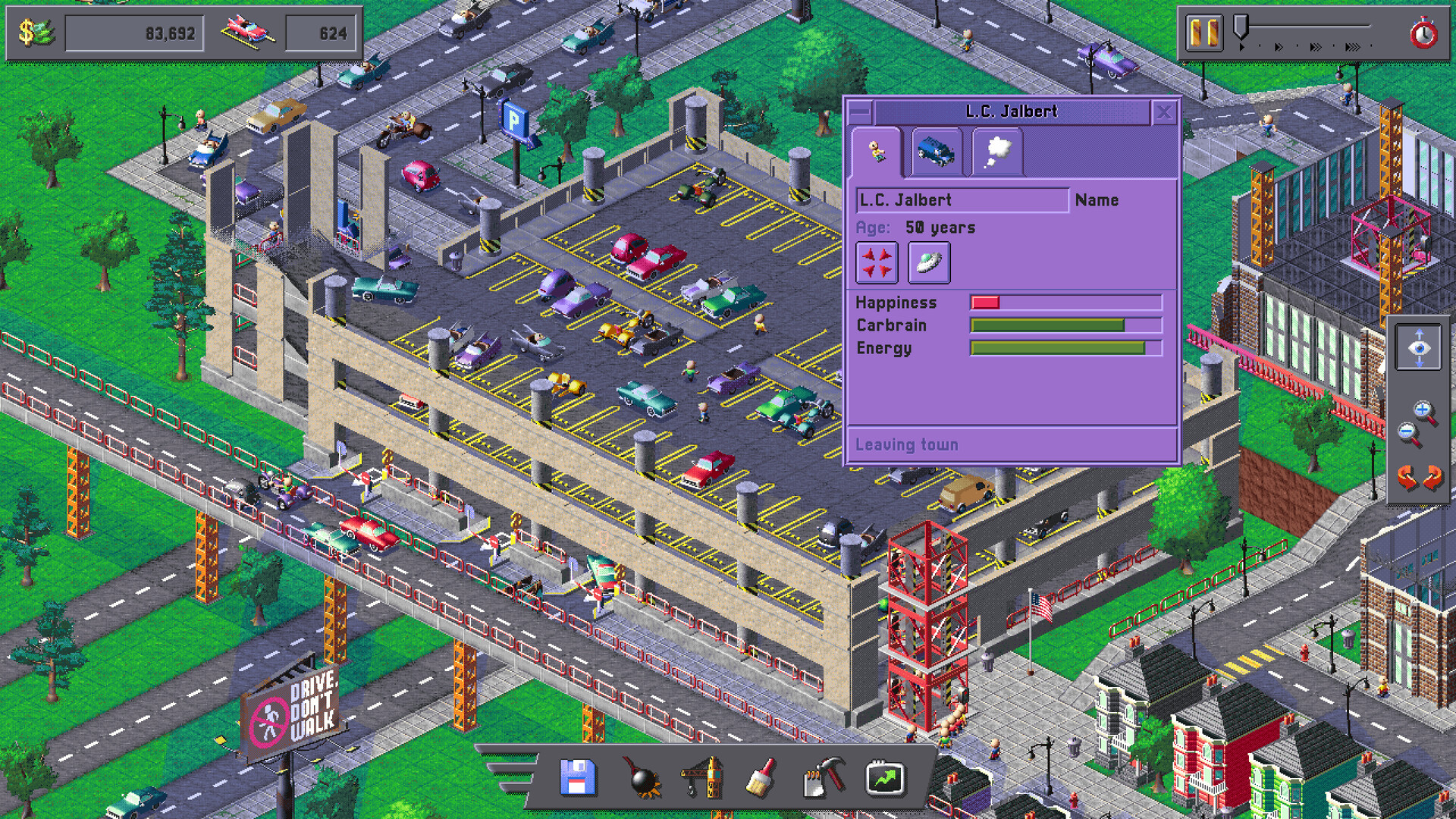
Open the tutorial before a main scenario. DeepSpaceMatt’s recording introduces camera movement and rotation, land purchase and the construction tools in that order. The cutaway camera options help expose the inside of a parking structure.
For a first attempt, keep the layout visible and compact. A small surface lot gives you fewer connections to inspect than a large garage. This is a learning recommendation, not a claim that flat parking earns more.
2. Build the lot in a clear sequence
- Buy the plot. Use the land tool to establish where you can build.
- Clear the build area. Remove rocks or other removable objects blocking your planned surface.
- Lay asphalt. In the tutorial, cars need a paved route rather than driving across unpaved ground.
- Place an entrance and an exit. Rotate each access piece to face the appropriate direction.
- Add parking bays. Keep their open side connected to the driving area.
- Observe a complete visit. Follow an arriving car through parking and departure.
Treat the last step as your acceptance check. A building that looks finished can still have a reversed access piece or an inaccessible row of bays. If a car stops, inspect that point before adding another row.
3. Read the yellow edge of a parking bay
The tutorial explains that cars enter a bay from the side without the yellow marking. Point that open side toward the driving aisle. Use rotation to correct the orientation before placing a whole row.
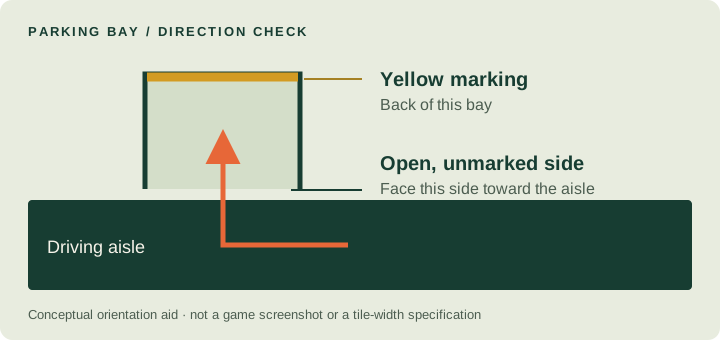
Do not use “it touches asphalt” as your only check. Inspect which side of the bay touches the aisle, then follow the route from that aisle to the exit. For a multilevel structure, use the camera’s cutaway view to inspect hidden connections.
4. Separate demand, ownership and opinion
An empty lot does not identify the problem on its own. Keep these three questions separate when deciding what to build:
| Question | Where to look | What to do with the answer |
|---|---|---|
| Do people want parking here? | The parking-demand overlay for this location. | Compare locations before buying more land. An available plot is not automatically a useful destination. |
| Are cars reaching buyers? | The car production, transport and sales sequence. | Inspect the supply handoffs; more parking spaces cannot fill a missing vehicle delivery. |
| How do residents feel about cars and prices? | Resident thoughts and carbrainness / needs information. | Read the actual feedback before spending on promotion or changing fees. |
Orbital Potato’s opening distinguishes existing car owners from the later car-production setup. The tutorial also shows public transport affecting parking demand. That makes the overlay more useful than assuming every neighborhood needs the same amount of parking.
5. Inspect the car supply chain
Orbital Potato’s opening setup introduces these three parts and selects the factory’s vehicle output. DeepSpaceMatt later builds the sales and supply setup as well.
Use the chain to locate a missing handoff. If a sales point has no vehicles, first inspect whether cars are being produced and transported. If vehicles reach the sales point but your lot remains empty, return to location demand and access. These observations point to different systems; rebuilding the parking lot would not test both.
6. Change fees with feedback
The tutorial opens parking-price controls through an entrance or exit and introduces willingness to pay. There is no single fee established by these recordings for every scenario.
Use a simple comparison: record the current fee and visible complaints, make one small adjustment, and observe another period of operation. If you simultaneously change fees, advertising and capacity, you cannot tell which change produced the result. Also distinguish a lot with no arrivals from a busy lot whose customers complain about price.
7. Decide what to improve next
| What you observe | Next inspection | Guide |
|---|---|---|
| Cars arrive but cannot get through. | Follow one route and find the first point where movement stops. | Traffic and exit checks → |
| The lot works, but repeating structures takes time. | Compare built-in blueprints with the community custom method. | Create and place blueprints → |
| You unlock fuel and stations run dry. | Trace production and delivery separately. | Follow the fuel chain → |
| You want to experiment outside the current scenario. | Distinguish a custom scene, a blueprint and a sandbox request. | Choose a mode → |
Before a major rebuild, save a working checkpoint. Keep your original small lot as a reference for orientation and connections while learning a new structure.
Beginner questions
Do roads have to be two or three tiles wide?
The reviewed material does not establish a universal width. The tutorial creator speculates about two lanes, and a forum player reports success after widening a road. Neither proves a minimum width for every layout.
Should I copy a creator’s exact prices and building counts?
Use their sequence to learn the tools. Their prices, city demand and unlocks belong to that recording; check your scenario’s feedback and current build before copying the numbers.
What counts as a working first lot?
For this guide, use a practical observation: a car can enter, reach a bay and leave. That confirms the route you observed, though it does not prove the layout can handle heavier traffic.
Sources & verification
Evidence: official information, attributed community methods and reviewed gameplay captions. The October 8 videos use a pre-release review build; captions and current menus may differ. We have not personally tested the game. Diagnostic examples are our reasoning tools, not measured game results.